Current article
To pursue its goal of ‘producing more with less’, RFM focuses on operational efficiency, aiming to enhance productivity while reducing resource consumption per unit of output.
Cotton variety evaluation
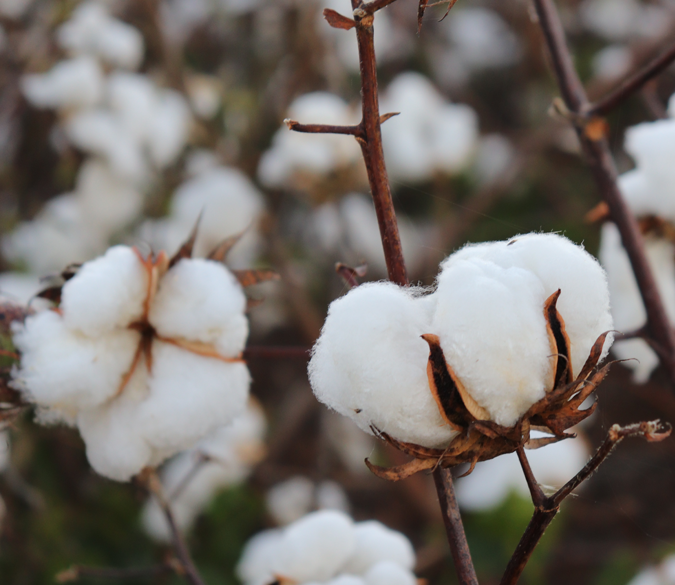
New cotton genetics need to perform not only in productivity but also in their suitability to the environmental conditions of RFM’s growing regions. A key focus in FY26 was a replicated, randomised cotton variety trial conducted at Lynora Downs in partnership with industry collaborators. The trial assessed seven new, pre-commercial varieties of cotton under field conditions for their yield, quality, input efficiency and resilience to the climatic variability within central Queensland.
Early results are encouraging for several varieties, with performance indicators suggesting possible potential for commercial adoption.
Green manure crops
RFM has been trialling green manure crops, starting at Mayneland in 2023 with a winter crop, vetch. Vetch is a legume, a plant that partners with nitrogen-fixing bacteria living in nodules on its roots to convert atmospheric nitrogen into a form plants can use. Green manure crops such as vetch are grown and then worked back into the soil, releasing that fixed nitrogen naturally and reducing reliance on fertiliser. Soil tests have confirmed an increase in soil nitrogen, rising from 65 kg/ha before the vetch was sown to 327 kg/ha after it was incorporated into the soil.
Building on previous results, in June 2026 a 500 ha trial summer crop of lablab, another legume, was grown on fallow irrigated fields at Lynora Downs and incorporated once it had reached maximum growth. Soil testing to measure the nitrogen benefit is underway.
Growing and incorporating legume green manure crops is a form of regenerative agriculture. It builds soil nitrogen and organic matter through natural biological processes, reducing the need for synthetic fertiliser and supporting long-term soil health. RFM will continue testing the approach over coming summer fallow periods, with plans to extend green manure crops into the regular rotation across its cropping operations where operational timing allows.
Integrated pest and disease management
In FY26, staff across RFM's macadamia operations undertook integrated pest and disease management (IPDM) training.
IPDM is a science-based approach to managing pests and diseases in crops through a combination of biological, cultural, physical and chemical methods, aimed at minimising reliance on synthetic pesticides, and underpins both the Bee Friendly Farming and Hort360 best management practice certifications by targeting pesticide use and supporting sustainable crop production.
.jpg)
Enhanced rock weathering trial
In FY26, RFM hosted a 15 ha trial of enhanced rock weathering (ERW), an emerging carbon dioxide removal technology, on one of RFF's Maryborough sugar cane properties, aimed at supporting carbon reduction across the sugar cane supply chain. ERW speeds up the natural breakdown of silicate minerals to capture atmospheric carbon dioxide: finely crushed silicate rock (typically basalt) is applied to agricultural soils, where it reacts with rainwater and carbon dioxide to store carbon in stable mineral and dissolved forms for long-term storage. The process has also been shown to release plant-available minerals, including calcium, magnesium and potassium, and to raise soil pH, improving soil health.
RFM identified the trial as an opportunity to test this emerging technology on an RFF-operated asset, with any potential soil health benefits remaining with the land beyond the trial and offering early insight into ERW's potential across RFF's broader portfolio. The trial is run by an Australian ERW company and funded by a multinational sugar buyer working to meet its own carbon reduction targets.
Sustainable macadamia production
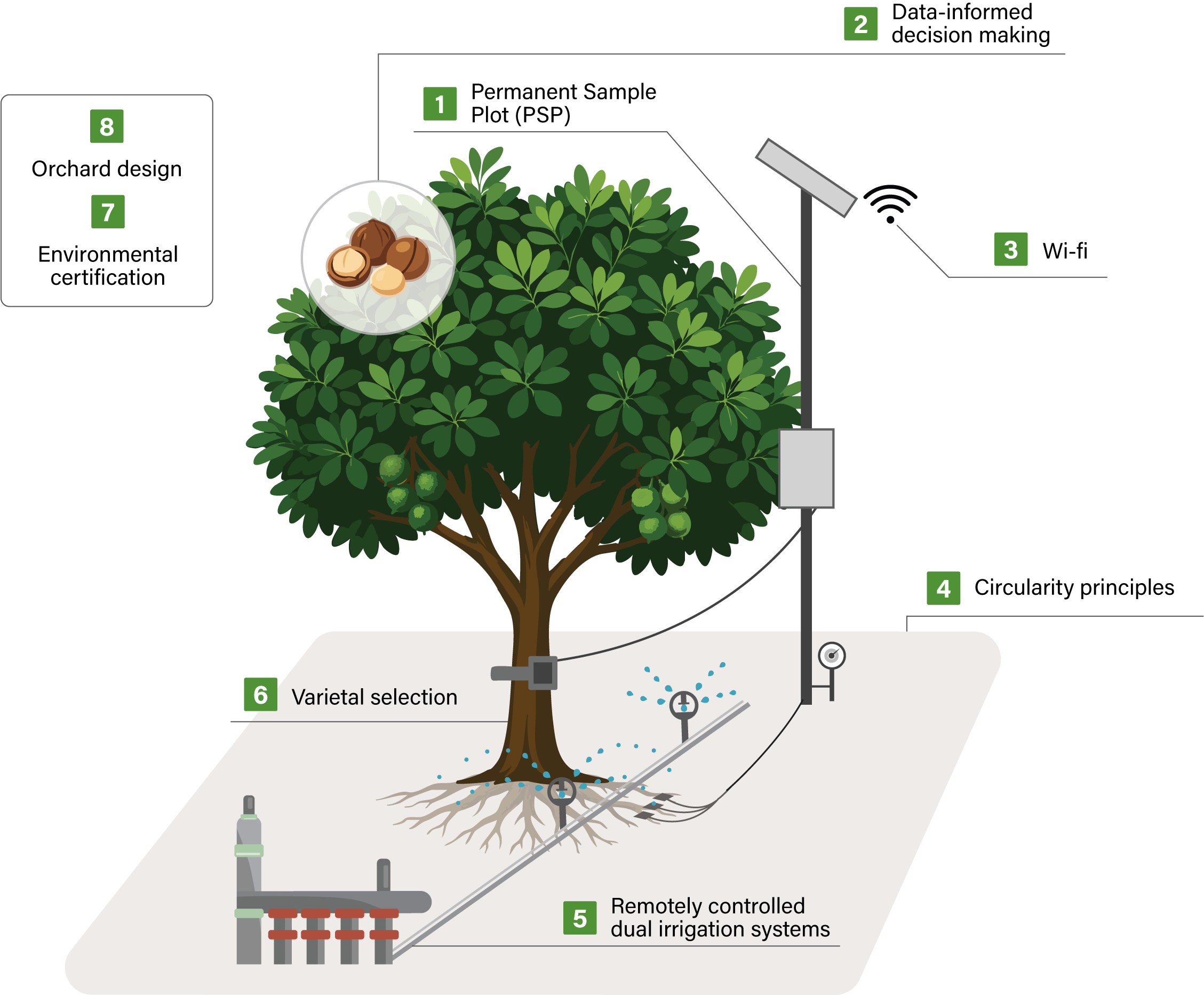
- Permanent sample plot (PSP): Solar-powered PSP sites in orchards collect tree and soil data using sap flow meters, soil moisture probes and dendrometers, alongside climatic and irrigation data.
- Data-informed decision making: Dashboards with PSP and orchard data for science-based decisions to maximise yields and optimise inputs.
- Wi-fi: Wi-fi mesh across the orchards enables PSP data transmission, remote infrastructure control, and employee access to an online safety platform, supporting a culture of safety and precision.
- Circularity principles: Macadamia husks and prunings are composted and applied across the orchards to enhance soil health, carbon levels, and water holding capacity.
- Remotely controlled dual irrigation systems: Dual, remotely controlled irrigation systems enable precise water application to support trees and interrow grasses, improve soil health, reduce erosion, and manage heat stress.
- Varietal selection: Higher-yielding cultivars producing quality nuts are planted throughout the orchard, with RFM and the University of Queensland collaborating to develop improved varieties.
- Environmental certification: Implementation of Hort360 Reef standards for practices to protect sensitive marine environments, such as the Great Barrier Reef, by minimising potential run-off from sediment and fertiliser.
- Orchard design: Orchard design uses diversion banks, grassed drains, and remnant vegetation to minimise sediment loss, maintain soil integrity, and promote biodiversity. Macadamia trees, remnant vegetation, and soil also act as carbon sinks, supporting environmental sustainability.
Notes:
- Graphic for illustrative purposes only. Not all of the systems outlined are included across all RFF orchards.