Current article
Under Australian Accounting Standards Board Sustainability Standard 2 (AASB S2), RFF is expected to be classified as a Group 3 entity, with mandatory climate-related disclosures applying to reporting periods beginning on or after 1 July 2027. Ahead of this requirement, RFF continues to disclose Scope 1 and Scope 2 emissions. This section sets out the Group’s approach to calculating and reporting greenhouse gas (GHG) emissions.
Organisational boundary
Consistent with the GHG Protocol the Group applies the operational control approach to determine its organisational boundary for reporting Scope 1 and Scope 2 GHG emissions. Under this approach, operational control exists where the Group has primary authority to establish and approve operating policies at an asset site.
RFF’s strategy primarily involves leasing agricultural assets, although the Fund may operate properties, for example during their development. These unleased assets sit within the Group’s operational boundary. Once a lease begins, operational control and responsibility for the associated Scope 1 and Scope 2 emissions transfers to the lessee. In future, in line with AASB S2 requirements, the Fund will report these lessee emissions as Scope 3 emissions (downstream leased assets) as defined by the GHG Protocol.
The Group’s Scope 1 and Scope 2 emissions sources for FY26 includes the following assets.
Cropping properties
- Yarra, located southwest of Rockhampton in central Queensland, 4,090 ha.
- Kaiuroo Aggregation, located northwest of Rockhampton in central Queensland, 27,863 ha.
- Seven Maryborough sugarcane properties located in Queensland, 1,785 ha. Macadamia orchards
- Swan Ridge and Moore Park, located in the Bundaberg region of Queensland, 234 ha. Beerwah, located in the Glasshouse Mountains of Queensland, and Bauple, located in the Wide Bay region of Queensland, 475 ha.
- Rookwood Farms (unleased portion), located in the Fitzroy region of Queensland, under development with 293 ha of newly planted and 401 ha of planned macadamia plantings.
Methodology and emissions sources
Scope 1 emissions are direct GHG emissions from sources controlled by the Group. These include emissions from agricultural activities such as enteric fermentation, manure management, urine and dung deposition, nitrogen-based fertiliser application, leaching and run-off, crop residues and atmospheric deposition, calculated with activity data using the Greenhouse Accounting Framework (GAF) tools. Emissions from fuel combustion, also captured in Scope 1, have been calculated with activity data using the Australian National Greenhouse Accounts Factors (NGAF) 2025.
Scope 2 emissions are from the generation of purchased electricity used in the Group’s operations. They are presented using the location-based method and calculated with activity data using the NGAF 2025 emissions factors.
Scope 1 and 2 emissions
RFF’s Scope 1 and Scope 2 emissions for FY26 remain modest relative to the size of the portfolio, reflecting the predominance of leased assets outside the Fund’s operational control. FY25 Scope 1 and Scope 2 inventory has been restated below following the reclassification of one property1. RFF reports the following FY25 and FY26 emissions.
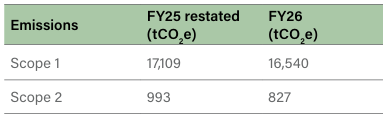
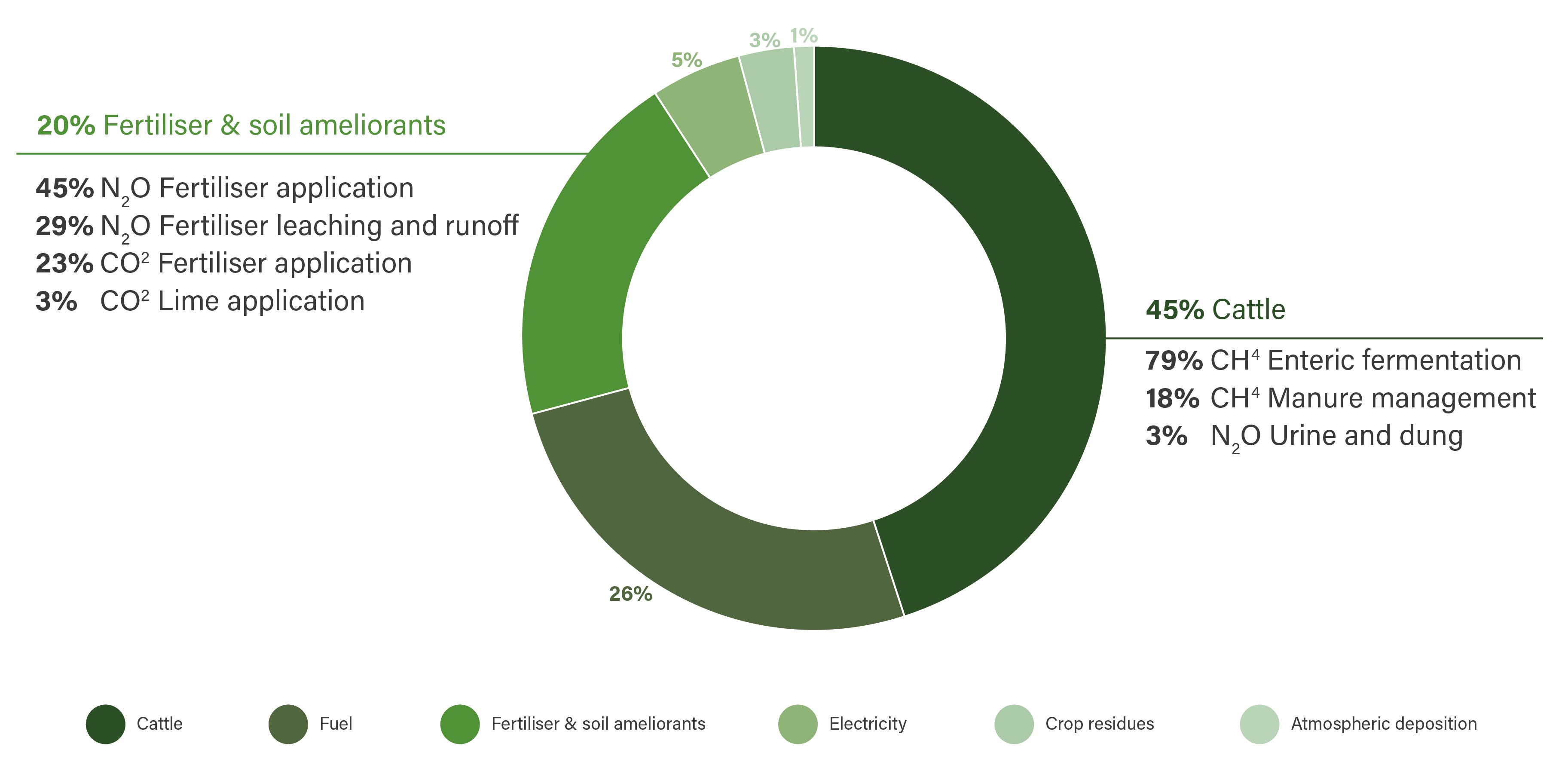
The Fund’s FY26 aggregated Scope 1 and Scope 2 emissions profile remained relatively consistent from FY25. While higher emissions were attributable to Rookwood Farms (unleased portion), Kaiuroo Aggregation and Yarra due to developments and operational changes, these were offset by Baamba Plains and Cerberus being leased (FY25) which removed both properties from the Scope 1 and 2 boundaries. Kaiuroo Aggregation and Yarra were recategorised as cropping in FY26 due to a change in operational focus but retained cattle operations.
In FY26, RFM completed an inventory review and implemented carbon accounting software that draws activity data directly from the Group’s financial system and applies the GAF tools to Scope 1 agricultural emissions. This investment improves the accuracy of emissions data and supports more precise application of the Group’s organisational boundary.
The Group’s emissions inventory does not currently account for potential carbon sequestration from soils, remnant vegetation or orchard biomass. Macadamia orchards illustrate this gap, whereby as trees mature, carbon accumulates in biomass such as trunks, branches and nuts, and root activity may also contribute to soil carbon. However, this sequestration has not been measured or independently verified across the Group’s macadamia assets, so it is not reflected in the reported emissions. As a result, these assets are reported above as net emitters.
Notes:
- FY25 Scope 1 and Scope 2 GHG emissions have been restated to reclassify the organisational boundary of Lynora Downs. Lynora Downs is leased by Cotton JV Pty Ltd, a 50:50 joint venture between RFF and RFM in which RFM holds operational control, and therefore is excluded from RFF’s Scope 1 and Scope 2 emissions (previously included in FY25 only).